Page 2 of 2
Posted: Wed Dec 22, 2010 11:38 am
by Marinus
Guppy wrote: what will be the angle at which line 3 is drawn?
An angle must always be between 2 lines; only one line can not have an angle.
Also what do you mean with: meet? They intersect? Then they can have any angle, unless line 1 and 3 are parallel. Actually I don't see the purpose of line 2 in your story.
Posted: Wed Dec 22, 2010 2:37 pm
by Guppy Star
Marinus wrote:Guppy wrote: what will be the angle at which line 3 is drawn?
An angle must always be between 2 lines; only one line can not have an angle.
Also what do you mean with: meet? They intersect? Then they can have any angle, unless line 1 and 3 are parallel. Actually I don't see the purpose of line 2 in your story.
Read the question well?
angle between 2 and 1 is 90, if line 1 is infinitely long, then line 3 will meet it only at infinity. So, the angle is approx 90 but actually 89.99999... onwards
Just try drawing it
Posted: Wed Dec 22, 2010 4:19 pm
by Marinus
I read it and it doesn't make any sense at all.
Line 2 has no purpose at all because a point on line 2 can be anywhere. So you draw a line 3 from " no matter where" to meet line 1. You still didn't say what you mean with "meet"; I'm not sure if that's a mathematical term, since I'm Dutch and don't know every mathematical terms in English. Again, if it's intersect, then it can be any angle between line 1 and 3 except zero
From your previous post I get the idea that you mean with "meet": at the end of line 1, which is impossible since line 1 is infinite. (Besides, in math every line is infinite.) From your story I get the idea that you mean an angle of 0 degree where you say 90 degrees. Well that's just the only angle when they never "meet" each other (unless they are at the same place) because they are parallel.
Posted: Wed Dec 22, 2010 4:31 pm
by Qloof234
Guppy Star wrote:Read the question well?
angle between 2 and 1 is 90, if line 1 is infinitely long, then line 3 will meet it only at infinity. So, the angle is approx 90 but actually 89.99999... onwards
Just try drawing it
What?
You can't "try drawing it" if Line 1's infinitely long. Additionally, citing Line 1 as perpendicular to Line 2 already makes the answer a 90-degree angle.
Posted: Wed Dec 22, 2010 10:41 pm
by StinkerSquad01
Any line goes on forever. In the US, we show that by putting an arrow at the end of the line segment viewed.
Posted: Wed Dec 22, 2010 10:46 pm
by Marinus
That's also how they teached me at school, so I guess those mathematic's rules are word-wide. (not only in the US) They talked about a line (which is infinite) or a line-piece (which has ends), or a half-line (which has one end and the other side infinite). At least that's how I remember it.
Posted: Thu Dec 23, 2010 5:23 am
by tyteen4a03
Math's rules are worldwide, jut some have their own theorys.
Posted: Thu Dec 23, 2010 4:16 pm
by StinkerSquad01
Line pieces are called line segments here, and half-lines are called rays here.

Posted: Sat May 07, 2011 7:48 pm
by jozsefkoma
Sorry for don't letting topic die but I found 2 new things.
1.
12345679*(n*9)=nnnnnnnnn
n=a number from 1 to 10 (except 10)
Example:
12345679*(4*9)=12345679*36=444444444
2.
Your age + the last 2 numbers from your birth year=a number
If you are born before 2000 your number is 111 and if your are born after 2000 your number is 11.
Example:(my age) 14+ 97(the last 2 numbers from birth year)=111
Posted: Sat May 07, 2011 7:52 pm
by MyNameIsKooky
jozsefkoma wrote:2.
Your age + the last 2 numbers from your birth year=a number
If you are born before 2000 your number is 111 and if your are born after 2000 your number is 11.
Example:(my age) 14+ 97(the last 2 numbers from birth year)=111
I think you'll get different numbers depending on what decade you're born in.
Posted: Sat May 07, 2011 7:55 pm
by Emerald141
pentachoron & others
Posted: Mon May 09, 2011 9:17 pm
by VirtLands
I love unusual math.
Here's an oddity in 4-D:
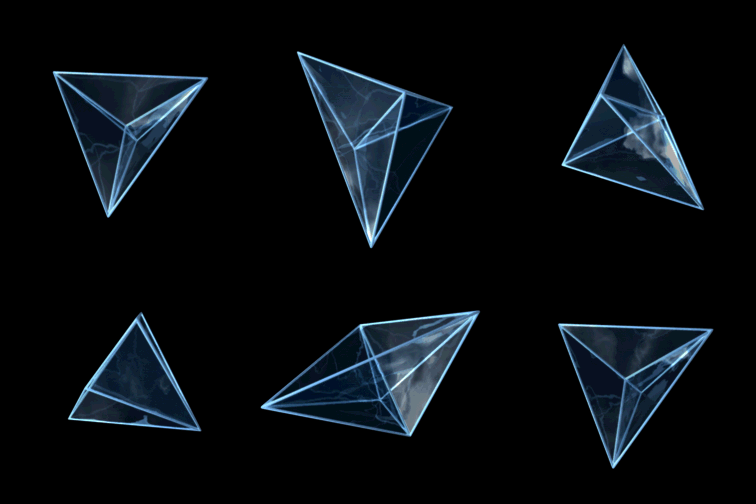
The 5-Cell is a four-dimensional object bounded by 5 identical tetrahedra, ..
The distance from each vertex to every other vertex is identical.
http://en.wikipedia.org/wiki/5-cell

_______________________________________________________________
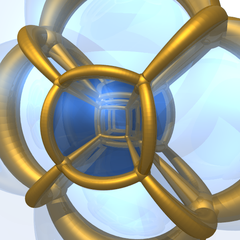
The
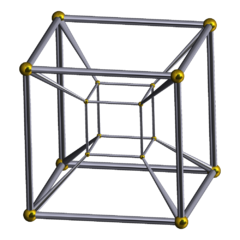
8-cell { = Tesseract }:
_______________________________________________________________
The 16-cell, consists of 16 identical 'cells';
each cell is a regular tetrahedron which looks squashed,
but only because it is in 4 dimensions.
Each edge in this figure is of identical length to every other edge.
http://en.wikipedia.org/wiki/16-cell

_______________________________________________________________
The 24-cell:
http://en.wikipedia.org/wiki/24-cell


_______________________________________________________________
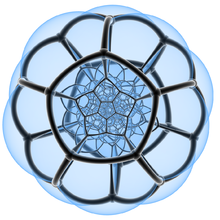
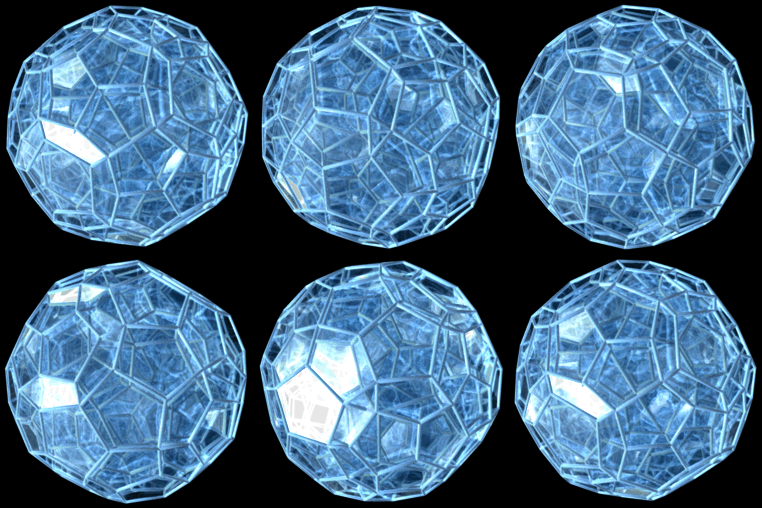
The 120-cell:
http://en.wikipedia.org/wiki/120-cell
_______________________________________________________________
The 600-cell:
http://en.wikipedia.org/wiki/600-cell


_______________________________________________________________
There is also a 5-dimensional cube,
..but it's too complicated, I give up... 
http://en.wikipedia.org/wiki/Penteract
Penteract:


Posted: Mon May 09, 2011 9:24 pm
by boywhoflies
EPIC.

Posted: Mon May 09, 2011 9:25 pm
by Marinus
That looks nice, but, although lots of the other things in this topic are too easy in my opinion, yours is too hard for me. I have no idea how there can be 4 dimensional object, while I only ever have lived in 3 dimensional space.
Posted: Mon May 09, 2011 9:27 pm
by boywhoflies
Hold on a sec. Isn't the 4th dimention time?
Posted: Mon May 09, 2011 9:28 pm
by Marinus
Yes, you can call time the 4th dimension, but how can time be part of an object?
Posted: Mon May 09, 2011 9:31 pm
by boywhoflies
That's the way I saw it.
Unless you count animation as time...I probaly sound so clueless right now.

Posted: Mon May 09, 2011 9:37 pm
by MyNameIsKooky
Marinus wrote:Yes, you can call time the 4th dimension, but how can time be part of an object?
An object has four dimensions:
-Length
-Width
-Height
-It's position in time
Posted: Mon May 09, 2011 9:44 pm
by Marinus
It doesn't matter if you count animation as time. If those are animations of objects, and the objects themselves are real, then the objects are not animations.
Kooky, but still time is not part of the object. The object can move, and in that case, its position in time changes, but the object itself doesn't change.
The object itself will only change, if one of the 3 dimensions of space are changing: width, length or height.
Posted: Mon May 09, 2011 9:52 pm
by boywhoflies
Marinus wrote:It doesn't matter if you count animation as time. If those are animations of objects, and the objects themselves are real, then the objects are not animations.
(Talking to Kooky here)
The object itself will only change, if one of the 3 dimensions of space are changing: width, length or height.
Good point.
Posted: Mon May 09, 2011 9:57 pm
by MyNameIsKooky
Marinus wrote:Kooky, but still time is not part of the object. The object can move, and in that case, its position in time changes, but the object itself doesn't change.
That's true, but nowadays, scientists and mathematicians consider time as the fourth dimension, although I'd prefer a fourth geometric dimension.
I saw the wikipedia page on tesseracts a while back. It was fascinating, but the objects are nearly impossible to visualize because our brains aren't made to comprehend them. On coordinate plans, all of the axes intersect at 90° angles. How would a fourth axis intersect through the origin? I've always wondered that.
Also, I found an interesting pattern.
A 1-dimensional line has 2 0-dimensional dots.
A 2-dimensional square has 4 1-dimensional lines.
A 3-dimensional cube has 6 2-dimensional squares.
Basically, an x-dimensional object has 2x (x-1)-dimensional objects. Thus we can conclude:
A 4-dimensional tesseract has 8 3-dimensional cubes.
A 5-dimensional hypercube has 10 4-dimensional tesseracts.
A 6-dimensional hypercube has 12 5-dimensional hypercubes.
...
A 125-dimensional hypercube has 250 124-dimensional hypercubes.
Posted: Mon May 09, 2011 10:06 pm
by Marinus
I'd prefer a fourth geometric dimension.
Me too. Even if you call time the fourth dimension, it's stil a fact that the 3 dimensions of space are all the same. There's actually no difference between length, width and height. It only depends on your viewpoint which one you call which one. But time is quite different then the 3 dimensions of space.
About the multi-dimensional things I think it's interesting, but again, since I only ever have lived in a 3 dimensional space, I can't imagine how it would be.